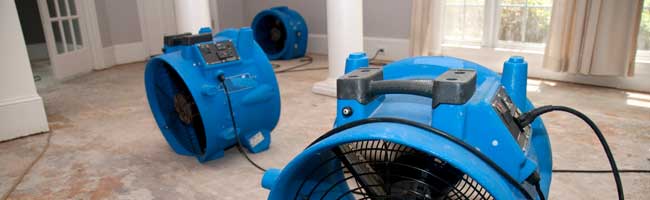
In a “hurry-up-and-wait” construction schedule, flooring represents high stakes. Wait too long, and the project goes over budget; install too quickly, and the floor fails. Contractors who navigate this dilemma are pushed and pulled between the needs of concrete and the demands of employers. Both sides are likely to embrace any method of speeding up a successful floor installation.
Dehumidification is one way to encourage concrete to dry more quickly. The process reduces the dew point of the air surrounding the slab, so that moisture within the concrete can evaporate from its surface. The building industry deploys dehumidification in three ways: desiccant drying, condensation dehumidification, and heat-based dehumidification.
Desiccant Drying
Desiccant-based dehumidifiers draw moisture from the air by adsorption. Humid air is moved across a desiccant material which binds and holds the moisture. The desiccant releases the moisture and vents it away from the slab in a hot air stream. The dried desiccant absorbs more moisture, and releases it again in a continuous moisture-removal cycle. The concrete dries a little more with each cycle. Because desiccant units keep working at low temperatures, builders can use desiccant dehumidification all year long.
Condensation Dehumidification
 The condensation process uses cooling-based dehumidifiers to collect moisture from the air. In this process, air comes in contact with a coil which cools it below its dew point (DP) temperature. As the air cools below the dew point, water vapor begins to condense into droplets on the surface of the cooling coil. The remaining air is drier and is, therefore, able to absorb more moisture. Another air stream is subjected to this process and the cycle creates a drier environment for moisture evaporation.
Heat-Based Dehumidification
Heat-based dehumidification warms the air, lowering its relative humidity so the surrounding air can absorb more concrete surface moisture. The saturated air is then circulated in one of two ways. It either goes through a moisture collection system, or it releases its excess moisture outside. Either way, evaporation can more easily occur due to lowered humidity around the slab.
Why HVAC Alone Falls Short
 Due to construction constraints, most standard HVAC systems are not run for enough time, or at all, to help dry the slab prior to receiving a moisture-sensitive flooring system. Many times this may be due to the cost of running the unit, the extra filtration and protection steps LEED construction air-quality credits require if the units run before occupancy, or extreme time constraints. Either way, the main issues are time and money. In order to have a successful installation of moisture-sensitive flooring material, one or the other is going to have to give to achieve the goal.
Enclose the Slab First
Successful dehumidification really requires that the concrete slab be fully enclosed so that moisture, once removed, is not re-introduced to the slab environment. Either the slab must be enclosed in service-ready indoor conditions, or a vapor barrier must be erected around it in outdoor conditions. Accurate relative humidity (RH) testing lets you accurately track moisture as it moves out of the slab. Once the desired RH levels are reached, the concrete will be optimally dried to sustain a quality floor finish for years to come.
Wagner Meters can help you accurately test the RH so you can track the moisture out of the slab during the dehumidification process. Wagner offers a variety of high-quality concrete moisture test kits that can verify the relative humidity level.