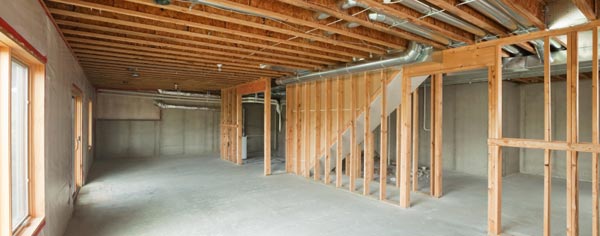
Strong, durable concrete requires proper slab moisture content (MC) assessment. Easily stated, but not-so-easily remembered when slabs are merely subfloors for fancier, more ornate forms of floor covering. Whether installing wood floors, carpets, vinyl flooring, or coating over concrete, the truth remains: slab moisture content is critical to the success of the floor itself.
Subfloor Integrity
When it comes to water content in concrete, what begins at the bottom ends up at the surface. Subfloor integrity is crucial because its strength and durability supports all floor coverings. Problems in the subfloor translate inevitably into problems with the floor itself.
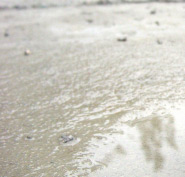 Subfloor moisture content is endemic to the slab installation process. No matter how concrete is mixed, there is always water content in concrete. Industry rule of thumb is to allow 30 days per inch of slab thickness for drying (not curing). During that time, given appropriate ambient conditions, moisture content migrates from the bottom of the slab to evaporate from its surface. Even after installing wood floors or laying vinyl flooring over concrete, however, slab MC continues to migrate within the slab until it is uniformly distributed through the entire thickness of the slab. This does not need to provoke moisture problems as long as installers have used a reliable concrete moisture test to verify that the slab is appropriately dry for the given finished floor product.
Excess slab moisture content, however, can sabotage the best-laid floor covering. Carpeting can become moist. Corners can develop mold along the walls. Adhesives can break down due to moisture content, and high pH, in between the subfloor and the vinyl, engineered wood or rubber floor covering. Concrete MC must be stabilized in order for the subfloor to bond with any subsequent floor covering. For these reasons, a concrete moisture test is a sound building investment.
Dry, Strong Concrete
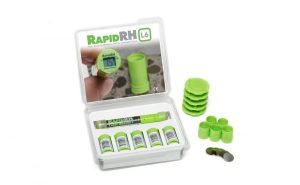 Wagner Meters, of Rogue River, OR, has researched and developed the Rapid RH moisture measurement system as a reliable and accurate way to measure slab moisture content. The Rapid RH® is based on relative humidity (RH) methodology. The industry has adopted RH as a dependable and accurate method for determining internal slab moisture content through standards such as ASTM F2170, and ongoing use and research continues to confirm RH testing as a reliable test for concrete slab moisture. That has not always been the case.
For many decades, the building industry relied on the surface readings of the anhydrous calcium chloride test (CaCl). Many contractors discovered perpetual slab performance problems related to internal moisture that went undetected. The Rapid RH system, from Wagner Meters, features in situ probes which are inserted into test holes at multiple slab locations. The probes indicate overall slab moisture content at 40 percent of the slab depth, the range proven to give the best indicator of final slab RH if it were to be sealed or covered at that point in the drying process.
Industry professionals, using the Rapid RH, can decisively identify overall slab moisture content in timely compliance with ASTM F2170. That way, floor covering contractors can begin installing wood floors or carpets or laying vinyl flooring over concrete without any residual subfloor moisture content concerns. Properly installed, concrete provides a strong and durable subfloor which supports all manner of properly installed floor coverings or coatings.